Drought halts one study, drone furthers data collection in another.
By Ellen Metrick Planet Contributor Oct 11, 2025
It happens. Every so often, dry weather means that August arrives without the visible fungi that Telluride Mushroom Festival folks flock here to study, eat and appreciate.
This year, the drought also stopped local scientist Evan Iverson from listening in on fungal conversations.
Among other things, Iverson has been working this year to provide insight into the ecological significance of fungal bioelectrical signaling with his BioElectrical Activity of Fungi (BEAF) study.
 “The goal of this project has always been to collect bioelectrical signal data in the wild on species that are of significant importance to our local forest ecosystems,” said Iverson, a mathematical physicist and director of science and research at Telluride Institute (TI).
Iverson conducts research through the Telluride Environmental Science and Engineering Laboratory (TESEL), which is housed under TI. Iverson founded TESEL in 2016.
Last winter, Iverson and his then-research assistant Chris Medary hatched the idea of measuring mushroom murmurings.
“Evan and I wanted to do something related to ecology, something publishable, and something we are really interested in, something to nerd out on,” Medary told the Planet in April for an article, published April 19, about the launch of the project.
“The original idea for BEAF was to do a phase of measurement (in the wild) before Telluride Mushroom Festival this year, then present at the festival and then do a second, more in-depth phase after,” Iverson explained.
That measurement involved hooking up mushrooms to electrodes to capture their bioelectrical impulses, much like a heart or brainwave study on mammals or similar activity in plants.
Iverson and Medary were working to replicate a study on mushroom language that British computer scientist Adam Adamatzky did a couple of years ago, with one change — they would do it on mushrooms living in the wild, not on lab-grown specimens.
“Over the past 10 years, the aspen trees on my property and in the surrounding national forest have yielded large flushes of pleurotus populinus (aspen oyster mushrooms) that would be perfect for the BEAF project,” Iverson said.
During summer 2025, Iverson and Medary worked with wild strains of mushrooms they bought from a commercial operation — similar to the wild ones they’d work with later — in a lab, in order to test Iverson’s equipment and methods.
That took them up through step eight of a 14-step process.
“Obviously, the impact of drought and adverse weather conditions on mushroom development this year had a huge impact on tasks 9-14,” Iverson said. “In fact, in the roughly 14 extensive mushroom-scouting forays I did before the (mushroom festival), I found not a single suitable flush of mushrooms anywhere suitable for field bioelectrical measurements.”
Art Goodtimes, a member of the TI board of directors and one of mushroom festival’s founders, noted that the dearth of mushrooms isn’t new.
“Over the last 46 years of my experience (in the Telluride region), at least one in five is a bad year for fungal fruiting,” he said. “And one in 10 is a zero, like this year. So, while not unexpected, it was disappointing for this study.”
The first eight steps did go well, Iverson said.
“I haven’t analysed all of the data yet and I’m still finishing up summer field work,” he explained, “but the equipment worked as we’d hoped.”
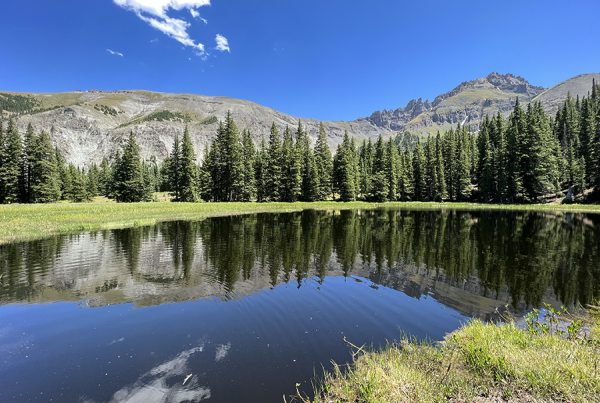
Some of that summer field work focused on microfungi and took place in the high alpine fens of Prospect Basin on the Telluride Ski Resort. His field report from work done in the fens in summer 2024 is available at tellurideinstitute.org/tesel and was funded by San Miguel County and the Town of Mountain Village.
Iverson has been working in the fens since 2019 on the Sensitive Wetlands Assessment and Monitoring Program (SWAMP), which consists of four projects. Under the SWAMP Biodiversity Project, Iverson is studying the DNA of the microfungi in the fens.
“This is a cool project and a new era for me,” Iverson said.
Up until now, he’s focused on visible plants and mushrooms, but the microfungi are integral to the ecosystems, too.
“There are plants in the fens known to be very reliant on these fungi,” Iverson said. “The microfungi actually move inside the plant roots and are instrumental in a number of functions.”
Iverson took the samples he collected this past summer and shipped them to Scripps Research in La Jolla, Calif., this week for DNA sequencing.
He’s also working with a somewhat new organization called the Society for the Protection of Underground Networks (SPUN), founded in 2021, whose focus is on fungi in the soil.