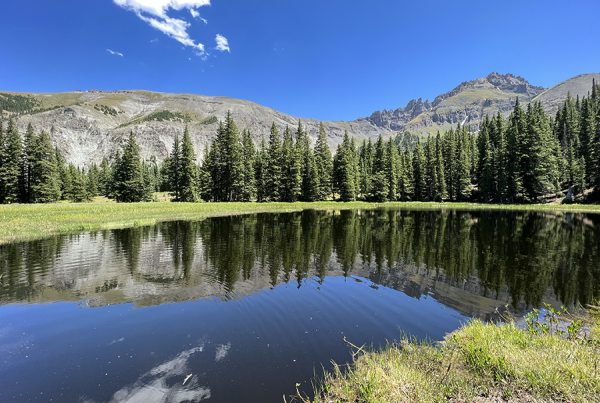
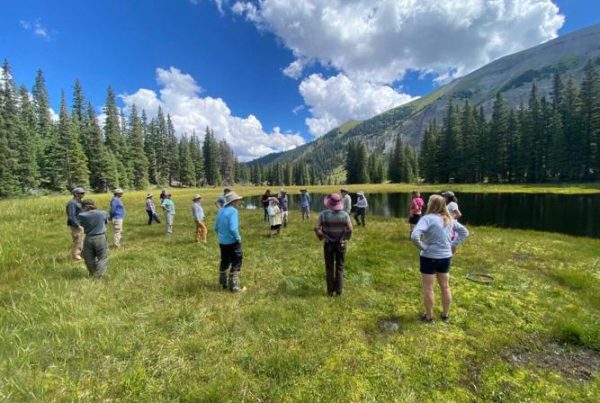
“Mountains Matter” is the tagline for the UN Mountain Partnership (UNMP) Summit, and as I ride up the chairlift at Ordino Arcalis in Andorra, I couldn’t agree more. The beauty, scale, and rugged majesty of the Pyrenees’ snow-capped peaks rising around me inspires something I can only describe as awe. In a few days, I will be surrounded by mountain experts from around the world, and their words will fall short of capturing what I feel at this moment. The Dr. Seussian “Yertle the Turtle” impulse to see what’s on the other side of every ridge. The pure joy of descending on a bluebird day. Of all the lessons I will take home, the most resonant is the simplest: to understand the mountains you need to be in the mountains and soak in their intrinsic power and ancient wisdom. Because while these peaks are both majestic and almost ephemeral, they have no human voice of their own, so they must speak through us. I sit on the chairlift, actively listening in silence.

The UN Mountain Partnership is dedicated to ensuring mountains are included in all levels of policy-making, scientific research, and environmental initiatives. Mountains are the headwaters for 60-80% the world’s freshwater, they shape global weather patterns, are home to 1.2 billion people with unique cultures and traditions, and provide downstream benefits to 2.2 billion more. Mountains also cover more than a quarter of the Earth’s land surface, host roughly half of the world’s biodiversity hotspots. Yet too often, policies are made at lower elevations, by non-mountain officials and industries that did not grow up imbued with reverence for these glorious and simultaneously harsh ecosystems. The UNMP brings together mountain champions from across the world to ensure that mountains are included at all levels of decision-making, and that successful projects and programs can be shared, replicated, and advanced across mountain communities. At the Summit, Hugo Mantilla-Meluk, from Colombia reminded us that while mountains have frequently been used as boundaries, they are actually places of connection that require and benefit from collaboration, sharing, and respect.
This year’s Summit convened under the theme “Mountains for the Future: Responsible Tourism, Thriving Communities,” spanning over 50 countries with 150 representatives. Panel discussions go beyond policy, bringing together scientists, NGOs, youth, government officials, and a variety of UN programs, with speakers representing multiple continents. English dominates the stage, but screens on either side translate everything into French, Spanish, and Catalan, and once people leave the stage, the hallways fill with languages from around the world. I am here representing Telluride Institute, alongside Aspen International Mountain Foundation (which hosted the last Summit in 2022), Western Colorado University, and Rocky Mountain Biological Laboratory. Together, we are the only North American representatives at this year’s Summit, a fact that feels daunting, sometimes awkward, but also quietly important.

Andorra, the host country, is a small nation nestled between France and Spain in the heart of the Pyrenees. Due to its geography, Andorra is inherently mountain-centric, a country that has learned to work with these peaks rather than against them. Ninety-six percent of Andorra’s land is in conservation, and the government is actively working to protect 30% of its territory by 2030 through the creation of a new national park that will double the size of its protected areas. Its towns and cities are carved into the valleys below, occupying the remaining four percent. Tourism alone accounts for 40% of Andorra’s GDP, not counting other mountain-related industries.
Sustainable tourism is a theme that echoes throughout the conference, and each country shares its stories of successes and cautions. The UN Secretary-General’s representative noted that 186 ski areas in the French Alps have already permanently closed, a stark testament to the mounting pressure climate change is placing on mountain livelihoods.

At a time when the world can feel so divided, especially if you’re from the US, there is something genuinely restorative about being united by a common cause that transcends borders. I attended the UNMP Summit in Aspen in 2022 as well, and one of my biggest takeaways this time is the shift in tone: away from pilot projects and test studies, toward a clear call to action. As the UN Deputy Secretary-General put it, we are moving toward the end of the 2030 Agenda, and the moment to turn commitment into concrete action is now. Speakers stressed the need for replicable, successful initiatives and the imperative to adapt, because the change is already here.
While at the conference, I received a newsletter from San Miguel Watershed Coalition, a Telluride nonprofit, reporting that due to low snowpack, the Colorado River would flow at just one-third of its usual capacity this year. Meanwhile, Andorra had just seen double its usual snowpack. These extreme fluctuations are the hallmarks of climate change, and for those of us who live in the mountains, who depend on them for our livelihood, our culture, and our personal joy, we must act as a community across borders, cultures, and industries while adaptation is still a feasible strategy. The adaptation finance gap makes this urgency concrete: mountainous developing countries need an estimated $187 billion per year to adapt, but international public finance reached only $13.8 billion in 2022.

Many panel discussions focused on policies being implemented by the UN, at various COPs, or by participating countries. We heard specifics and stories of success, including from a municipality in Andorra now producing the majority of its energy through hydropower and biomass. With energy prices spiking around the world, the message was consistent: energy independence is energy security, especially for frequently isolated mountain communities. Speakers also stressed the importance of carrying mountain priorities into upcoming global processes, including a dedicated dialogue on mountains and climate change scheduled for the next UNFCCC Subsidiary Body meeting in Bonn, Germany.
For me, the most moving panel was the youth panel, where six remarkable leaders, not of tomorrow but of today, shared their experiences, hopes, and pathways to solutions. Their stance wasn’t built on hope so much as determination, on the conviction that the world must change and that they must lead now. Amos Amanubo from Uganda put it plainly: if you’re not at the table, you’re on the menu. This generation cannot wait for permission to sit down. They need to take their seat, because they are the ones who will live with the consequences of today’s decisions. One speaker stressed that “global action” is not only sweeping declarations, but a collection of small actions that, when connected, become global movements. These young leaders understood the importance of interdisciplinary approaches, and while they can all benefit from more mentorship and experience, they are ready to act. We just need to get them a seat at the table and learn together in the process. Several participants called for youth to be given a formal seat on the UNMP Steering Committee, a conversation the Partnership will carry forward.
Every four years, the UNMP Summit produces a declaration approved by its steering committee. This year’s Andorra Declaration included new elements such as the “One Health Initiative,” which draws an explicit link between ecosystem health and human health. The Declaration commits members to promote sustainable and climate-resilient tourism, empower Indigenous Peoples and local communities, strengthen international collaboration, and build capacity for monitoring social and ecological change in mountain regions. The steering committee is elected by members from each continent; for North America, Aspen International Mountain Foundation retained its seat, with Telluride Institute added as an alternate. The committee will be tasked with carrying the declaration into policies and projects around the world, and with planning the next Summit in Bishkek, Kyrgyzstan, in 2027, marking 25 years since the Mountain Partnership was founded.

As host country, Andorra’s minister of foreign affairs closed the Summit with a call to action, urging all present to move forward “with foresight, solidarity, and a strong sense of shared responsibility.” Mountains matter, and it is our charge to make sure that message reaches decision-makers everywhere. This article is one small step in that effort. When I get home, I also plan to take my son skiing, to make sure another generation has the chance to listen to the peaks, feel change through lived experience, and see a path forward. Because this is a year of action. Here’s where I’m starting:
My Actions Steps:
- Deepen the Local Connection: Share the UNMP Summit Declaration with Telluride’s government and nonprofits.
- Strengthen Alliances: Bolster the collaboration between Telluride Institute, Aspen, RMBL, and Western Colorado University.
- Champion Advocacy: Encourage the towns of Telluride and Mountain Village to join the UNMP.
- Share: Provide examples of TI’s successes and challenges to the UNMP as examples for other organizations and regional governments.
- Show Up: Attend UNMP steering committee meetings to ensure the voice of the American West is heard.
- Stewardship: Imbue love, knowledge, and respect for mountain cultures in my family and community.
Post script: When I came home Mt. Hood Meadows announced that they would close April 12th this year, a full month earlier than normal. Year to date snow totals are at 236” a full 100 inches below average. Despite my best efforts my son has declared this ski season over for him and we are headed to the OR coast instead for Spring Break. Maybe next year will be our year to have double our average snowfall like Andorra did this year. Either way we will be in the mountains and on the rivers and streams they feed, listening, learning and whenever possible advocating on their behalf.
Tucker Szymkowicz
Development & Programs Director
Telluride Institute